
Step-By-Step Lesson Plan for teaching Grade 7-9 students how to add positive and negative integers.
Teaching students to confidently add positive and negative integers can feel like trying to untangle a slinky—especially if they’ve developed misconceptions early on. But with a bit of movement, some real-world context, and structured modelling, this lesson can be one of the most satisfying to teach.
This blog shares an explicit lesson plan I’ve refined over the years to explicitly teach these foundational number skills. Aligned to the Australian Curriculum Version 9 (AC9M7N07).

LESSON 1: Adding Positive and Negative Integers
🔥 Suggested Warm-Ups
Start by activating prior knowledge:
-
Human number line – This is my favourite!! Use masking tape or chalk to make a number line with 40 marks representing numbers. Hand each student a Post-It note with a number on it between -20 to 20. Students need to work together to organise and arrange themselves in order on the number line. This gets students moving and engaged. To add a little extra – have students complete the activity in complete silence!
OTHER WARM-UP IDEAS
-
Base 10 rapid recall – Revise addition/subtraction fact fluency.
-
‘Round the World’ – Fast-paced game for quick mental maths.
🎯 Lesson Intent & Success Criteria
Today we’re learning to add positive and negative integers.
Students will be successful when they can:
-
Order positive and negative numbers on a number line.
-
Add positive and negative numbers.
-
Solve problems involving integers.
Step 1: Describe Integers
Explain that integers are whole numbers that can be positive, negative or zero. Clarify with examples and non-examples:
-
✅ Integers: -5, 0, 4, 3,043
-
❌ Not integers: -1.43, ¾, 3.14
Step 2: Order Integers
In small groups, give students sets of numbers to sort. You could also write the sets on the boards and students use student whiteboards to order each set:
-
9, -6, 4, -10 -
18, 0, -7, 3 -
104, -648, -150, -16
This reinforces understanding of value and direction.
I DO: Explicitly Model How to Add Positive and Negative Integers

Use a large classroom number line and demonstrate each step physically:
-
Locate the first number on the number line.
-
Face the direction of the operation sign (addition … look right).
-
If adding a negative, step backward the number of places.
-
If adding a positive, step forward the number of places.
Model: 3 + -9 = -6
WE DO: Guided Practice
Together, solve: 7 + -16
Ask:
-
Which number do we start on?
-
Which direction do we face?
-
Which direction do we walk?
-
How many steps?
Continue practicing number sentences together slowly releasing responsibility onto the students.
👍 CFU – Confidence Check
Have students show:
-
👍 = Confident
-
🤏 = Almost there
-
👎 = Need help
👍Students who identify they are confident with the learning – move onto independent practice.
Thumbs on the side (nearly there) and Thumbs down (not confident at all) continue working with you for more WE DO practice. Slowly releasing students to independent practice.
YOU DO: Independent Practice
Students complete individual work:
-
-15 + 8 -
5 + -6 -
25 + -13 -
45 + -3 -
-5 + 8 -
-9 + 18
Students complete multiple worded problem-solving questions where they comprehend the situations involving the addition of positive and negative numbers.
Exit Ticket
Before leaving, students must solve one integer sum. In small groups, they review answers and explain any errors.

Want to Save Time Planning? 📥
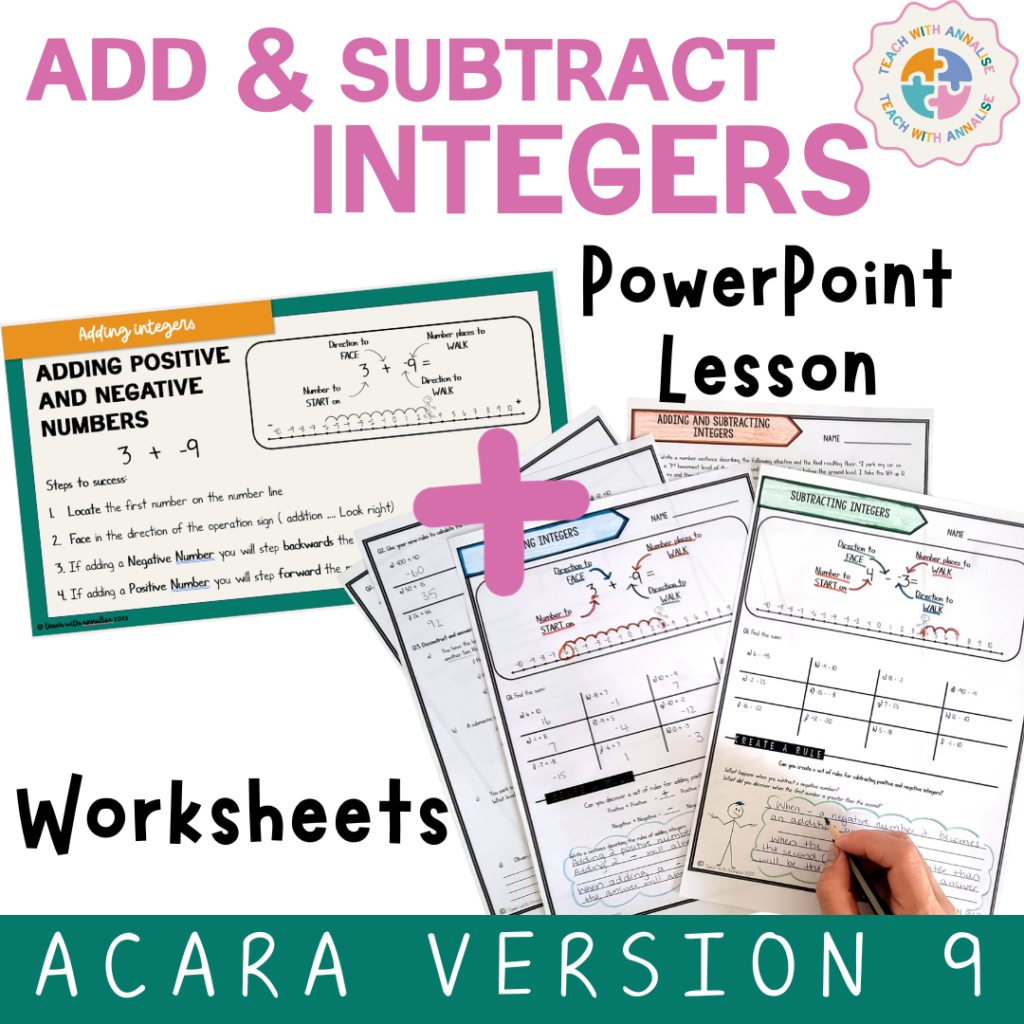
If you’d love to have this lesson already designed, prepped, and differentiated, check out my Adding and Subtracting Integers PowerPoint and Worksheet Pack.
✅ Curriculum aligned (AC9M7N07) ADD and SUBTRACT positive and negative numbers
✅ PowerPoint – content rich with embedded answers
✅ Differentiated worksheets (digital + print)
✅ ALL answers included
👉 Also explore my fun Integer products that are perfect for revision:
Let’s make integers engaging and clear—so your students feel confident and successful from the very first step. 💪